Online work has evolved rapidly over the last decade. From basic email communication to fully digital workflows, modern professionals now rely heavily on online tools to manage tasks, collaborate, and deliver results. A new development is accelerating this transformation: AI agents.
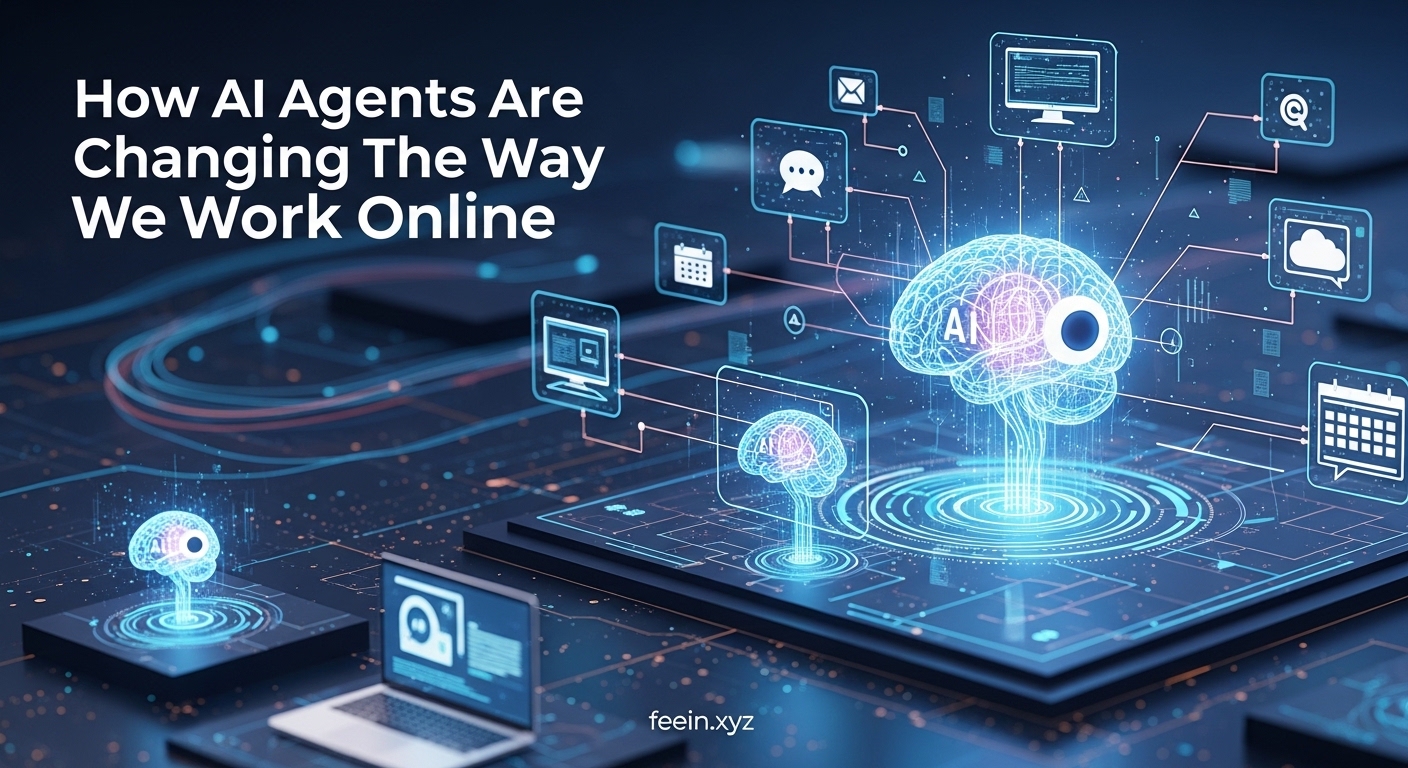
AI agents are intelligent systems designed to perform tasks, make decisions, and assist users with minimal manual input. Unlike traditional automation tools, AI agents can analyze context, adapt to new information, and complete multi-step workflows.
This shift is changing how individuals and teams work online. Instead of manually handling repetitive processes, users can rely on AI agents to assist with planning, research, communication, and task execution.
In this article, we explore how AI agents are changing the way we work online, including real-world use cases, benefits, limitations, and what to expect in the near future.
What Are AI Agents?
AI agents are software systems that can perform tasks autonomously or semi-autonomously. They use machine learning, natural language processing, and data analysis to understand instructions and complete actions.
Unlike simple automation scripts, AI agents can:
- Understand written instructions
- Analyze multiple data sources
- Perform multi-step tasks
- Adapt to changing inputs
- Provide recommendations
For example, an AI agent might:
- Summarize long documents
- Draft emails
- Organize project tasks
- Research topics
- Generate reports
This ability to handle complex workflows makes AI agents useful for online work environments.
How AI Agents Differ From Traditional Automation
Traditional automation tools follow fixed rules. AI agents, however, can interpret context and adjust their actions.
| Feature | Traditional Automation | AI Agents |
|---|---|---|
| Rule-based tasks | Yes | Yes |
| Context understanding | No | Yes |
| Multi-step workflows | Limited | Yes |
| Learning capability | No | Yes |
| Natural language instructions | No | Yes |
This flexibility allows AI agents to handle tasks that previously required manual input.
Real-World Use Cases of AI Agents in Online Work
1. Research and Information Gathering
AI agents can quickly scan large amounts of content and extract key insights. This is useful for:
- Writing reports
- Market research
- Competitive analysis
- Content planning
Instead of spending hours reading multiple sources, users can receive summarized insights.
2. Email and Communication Assistance
AI agents can help draft responses, organize inboxes, and prioritize messages. This reduces time spent managing communication.
Common uses include:
- Drafting replies
- Summarizing long threads
- Categorizing emails
- Creating meeting notes
These features improve efficiency, especially for remote teams.
3. Task Management and Planning
AI agents can help structure workflows by:
- Breaking projects into tasks
- Suggesting timelines
- Prioritizing work
- Tracking progress
This reduces the need for manual planning and improves consistency.
4. Content Creation Support
AI agents assist with:
- Drafting outlines
- Generating ideas
- Editing text
- Improving readability
They do not replace human creativity but help speed up the process.
5. Data Analysis and Reporting
AI agents can analyze data and produce simple reports. For example:
- Website traffic summaries
- Performance metrics
- Trend identification
This helps users make informed decisions more quickly.
Benefits of AI Agents for Online Work
Increased Productivity
AI agents reduce time spent on repetitive tasks, allowing users to focus on higher-value work.
Faster Decision Making
Quick summaries and analysis help users evaluate information efficiently.
Reduced Manual Work
Automating routine tasks minimizes effort and improves workflow consistency.
Improved Organization
AI agents help structure tasks, documents, and communication.
Accessibility for Non-Technical Users
Natural language interfaces allow users to interact without technical knowledge.
Challenges and Limitations
While AI agents offer advantages, they also present challenges:
Accuracy Considerations
AI-generated outputs may require review. Users should verify important information.
Context Limitations
AI agents may not fully understand highly specialized workflows.
Privacy and Data Concerns
Users should avoid sharing sensitive data unless using trusted platforms.
Over-Reliance on Automation
Relying too heavily on AI may reduce human oversight.
Balancing automation with human review is important.
Best Practices for Using AI Agents Effectively
To get the most value:
Use Clear Instructions
Provide detailed prompts to improve results.
Review Outputs
Always verify important information.
Combine With Human Judgment
AI agents assist, but decisions should remain human-led.
Start With Small Tasks
Begin with repetitive workflows before expanding usage.
Maintain Data Awareness
Avoid sharing confidential information unnecessarily.
How AI Agents Are Shaping the Future of Online Work
AI agents are expected to become more integrated into everyday tools. Future developments may include:
- Multi-tool automation across platforms
- Smarter scheduling assistants
- Real-time workflow optimization
- Context-aware task suggestions
- Intelligent collaboration support
These improvements aim to make online work more efficient and less repetitive.
Practical Example: A Day Using AI Agents
A remote worker might use AI agents to:
- Summarize overnight emails
- Generate a daily task list
- Research a topic
- Draft a report outline
- Create meeting notes
This reduces manual effort and saves time throughout the day.
AI agents are changing the way people work online by automating repetitive tasks, improving organization, and assisting with decision-making. While they do not replace human expertise, they serve as valuable tools for improving efficiency and productivity.
As AI technology continues to evolve, AI agents are likely to become a standard part of digital workflows. Understanding how they work helps individuals and teams use them effectively while maintaining control over their processes.
FAQ
What is an AI agent?
An AI agent is a software system that can perform tasks, analyze information, and assist users using artificial intelligence.
Are AI agents the same as chatbots?
No. Chatbots focus on conversation, while AI agents can complete multi-step tasks and workflows.
Do AI agents replace human work?
AI agents assist with repetitive tasks but still require human oversight.
Are AI agents useful for individuals?
Yes. They can help with organization, research, writing, and planning.
Is it safe to use AI agents?
It depends on the platform. Users should avoid sharing sensitive information and review privacy policies.