If you compare a computer or smartphone from ten years ago to a modern device today, one major difference quickly stands out: the amount of RAM.
Older computers often worked with 2GB or 4GB of RAM, while many modern laptops and smartphones now come with 8GB, 16GB, or even more. For many users, this raises an important question:
Why do modern devices need so much RAM today?
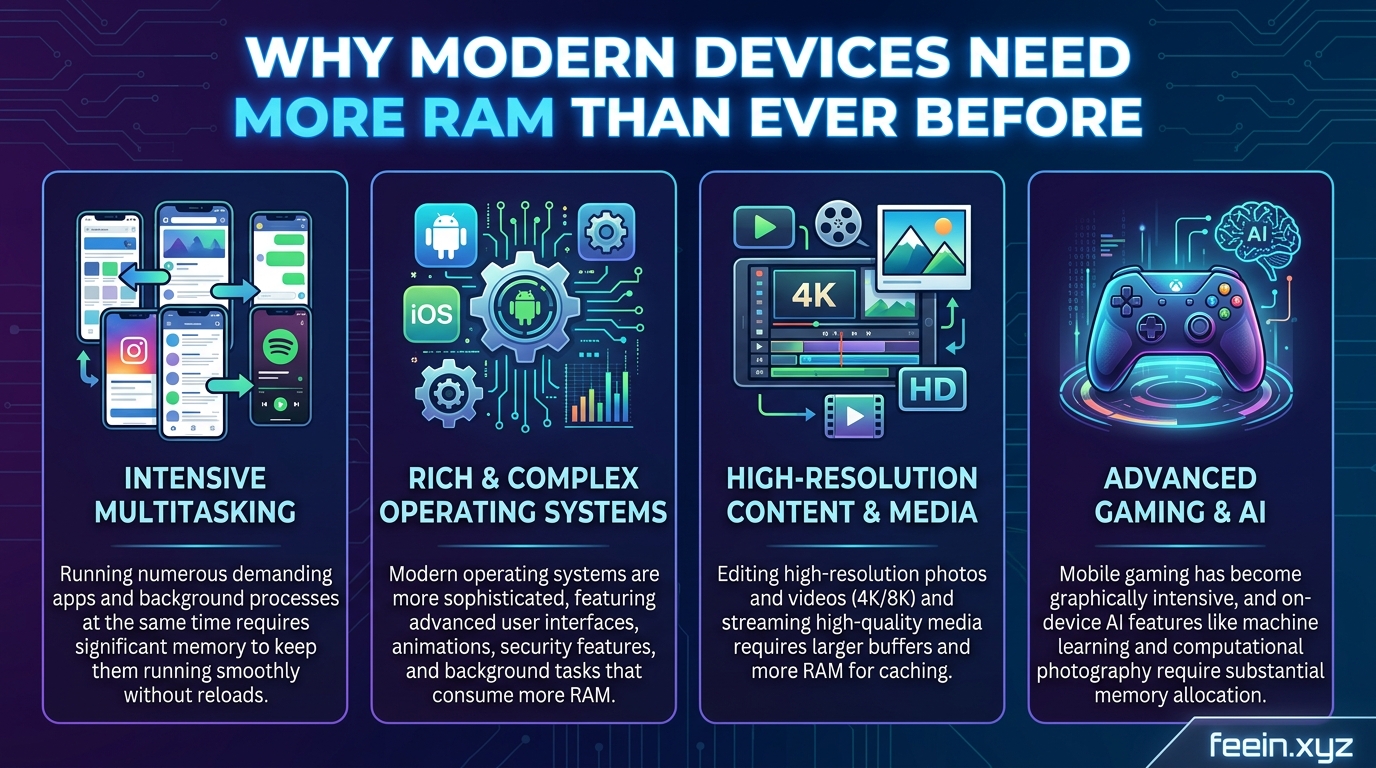
The answer is more complex than simply saying “software is bigger.” Modern technology has changed dramatically. Applications are more advanced, operating systems are more demanding, and users now expect seamless multitasking, instant responsiveness, and AI-powered features.
In this guide, we’ll explore:
- What RAM actually does
- Why modern devices consume more memory
- Real-world examples of RAM usage
- Common misconceptions
- How much RAM most people actually need
This article focuses on practical understanding rather than technical jargon, making it easier to understand how RAM affects everyday digital experiences.
What Is RAM?
RAM stands for Random Access Memory.
It is the short-term memory your device uses while running applications and processes.
Unlike permanent storage devices such as SSDs or hard drives, RAM temporarily stores active data that the processor needs immediate access to.
Think of RAM like a workspace on a desk:
- The larger the desk, the more items you can work with simultaneously.
- A smaller desk forces you to constantly remove and reorganize items.
In the same way, insufficient RAM forces devices to repeatedly move data between memory and storage, which slows performance.
Why Devices Today Use More RAM
Modern devices are expected to handle far more tasks than older systems ever did.
Several technological shifts explain why RAM demands continue to increase.
1. Modern Applications Are More Complex
Software today is significantly more advanced than it was a decade ago.
For example:
- Web browsers run like mini operating systems
- Video editing software processes high-resolution media
- Games render detailed graphics in real time
- Collaboration platforms handle live video, chat, and file synchronization simultaneously
Even simple websites now include:
- animations,
- background scripts,
- live updates,
- embedded media,
- AI-driven features.
As software complexity increases, memory requirements naturally rise as well.
Real-World Example: Browser Memory Usage
Years ago, opening five browser tabs was normal.
Today, many users open:
- email,
- video streaming,
- cloud documents,
- messaging apps,
- social media,
- project dashboards
—all at the same time.
Modern browsers isolate tabs into separate processes for security and stability. While this improves safety, it also increases RAM usage.
In some cases, a single browser session can consume several gigabytes of memory.
2. Multitasking Has Become Standard
Modern users rarely run one application at a time.
A typical workflow today might include:
- video conferencing,
- cloud storage syncing,
- music streaming,
- multiple browser tabs,
- messaging platforms,
- productivity software
—all running simultaneously.
RAM allows devices to keep these applications active without constant slowdowns.
Without enough memory:
- applications freeze,
- switching between tasks becomes slow,
- systems rely heavily on storage-based virtual memory.
This is one reason why devices with low RAM often feel sluggish after prolonged use.
3. Operating Systems Are More Advanced
Modern operating systems include many background services designed to improve usability and security.
These include:
- automatic updates,
- real-time antivirus scanning,
- cloud synchronization,
- voice assistants,
- AI-enhanced search,
- system indexing,
- visual effects.
While these features improve user experience, they also require additional memory resources.
For example, a modern operating system may use several gigabytes of RAM before the user even opens any applications.
4. High-Resolution Content Requires More Memory
Digital content today is far more demanding than older media formats.
Examples include:
| Content Type | Older Standard | Modern Standard |
|---|---|---|
| Video | 480p | 4K / 8K |
| Images | Low Resolution | High Resolution HDR |
| Games | Basic Textures | Realistic 3D Assets |
| Apps | Static Interfaces | Dynamic Interactive UI |
Handling larger files and visual assets requires significantly more memory.
For example:
- photo editing high-resolution images,
- streaming 4K video,
- rendering 3D graphics
all increase RAM usage dramatically.
5. Artificial Intelligence Features Consume Memory
AI-powered features are becoming increasingly common in modern devices.
Today’s systems may include:
- AI photo enhancement,
- voice recognition,
- predictive text,
- live translation,
- smart assistants,
- AI search tools.
These processes often run continuously in the background.
Machine learning models require memory to:
- process data,
- store temporary calculations,
- maintain responsiveness.
As AI integration grows, RAM requirements are expected to continue increasing.
6. Gaming Has Changed Completely
Modern gaming places enormous demands on system memory.
Today’s games include:
- detailed environments,
- realistic physics,
- online multiplayer systems,
- real-time rendering,
- high-resolution textures.
Games also frequently load large open worlds into memory to reduce loading times.
As a result:
- 16GB RAM has become common for gaming PCs,
- some professional setups now use 32GB or more.
This is not only about graphics quality — it’s also about maintaining smooth performance during complex real-time calculations.
Common Misconception: More RAM Does Not Always Mean Faster
Many people assume adding RAM automatically makes every device faster.
This is only partially true.
RAM helps when:
- the system frequently runs out of memory,
- multitasking is heavy,
- applications are memory-intensive.
However, performance also depends on:
- CPU power,
- storage speed,
- software optimization,
- cooling systems.
A balanced system performs better than simply maximizing RAM alone.
How Devices Manage Low RAM
When RAM becomes full, systems use a method called virtual memory.
This temporarily moves inactive data to storage devices such as SSDs.
While this prevents crashes, storage is much slower than RAM.
This leads to:
- lag,
- delayed app switching,
- reduced responsiveness.
Devices with insufficient RAM may technically continue operating, but user experience often suffers significantly.
How Much RAM Do Most People Actually Need?
The ideal amount depends on usage.
Basic Usage
For:
- web browsing,
- streaming,
- email,
- office tasks
8GB is often sufficient.
Multitasking & Productivity
For:
- remote work,
- multiple apps,
- large spreadsheets,
- creative tasks
16GB provides a more comfortable experience.
Gaming & Professional Work
For:
- video editing,
- 3D rendering,
- advanced gaming,
- software development
16GB–32GB may be appropriate depending on workload.
Why RAM Requirements Will Continue Increasing
Technology continues evolving toward:
- cloud-connected systems,
- AI-enhanced software,
- richer graphics,
- larger datasets,
- real-time collaboration.
As software capabilities grow, memory requirements will likely continue increasing over the coming years.
This trend reflects changing expectations around speed, convenience, and multitasking.
Modern devices require more RAM because digital experiences have become far more advanced than they were in the past.
Today’s systems handle:
- complex applications,
- AI-powered features,
- high-resolution media,
- constant multitasking,
- cloud synchronization,
- advanced gaming environments.
RAM plays a critical role in maintaining smooth performance and responsive computing.
Understanding how memory works helps users make smarter decisions when choosing laptops, smartphones, and other digital devices.
Rather than focusing only on large numbers, it’s more important to understand how RAM supports real-world usage and overall system balance.
Frequently Asked Questions
Does more RAM improve gaming performance?
Additional RAM can improve gaming performance if the system previously lacked sufficient memory. However, graphics cards and processors also play major roles.
Is 8GB RAM enough in 2026?
For basic everyday tasks, yes. For heavy multitasking or demanding software, many users now prefer 16GB or more.
Why do smartphones now include more RAM?
Modern smartphones run advanced apps, AI features, high-resolution cameras, and background processes that require additional memory.
Can too much RAM be unnecessary?
Yes. Installing more RAM than your workload requires may provide little noticeable benefit.
What happens if RAM becomes full?
The device begins using slower storage-based virtual memory, which can reduce responsiveness and overall performance.