Remote work is no longer just a temporary shift — it has become a long-term operating model for companies worldwide. However, managing remote teams efficiently still presents challenges such as communication gaps, task misalignment, and reduced visibility.

In 2026, AI-powered collaboration tools are reshaping how teams work together. These tools are not just improving communication — they are actively assisting teams by analyzing data, automating workflows, and reducing manual effort.
This article explores how AI collaboration tools are transforming remote work, using real-world scenarios, practical examples, and actionable insights you can apply immediately.
What Makes AI Collaboration Tools Different?
Traditional collaboration tools focus on:
- Messaging
- Video calls
- File sharing
AI-powered tools go further by:
- Automatically summarizing meetings
- Suggesting next steps
- Detecting delays in projects
- Prioritizing tasks based on behavior patterns
This shift moves tools from passive platforms to active assistants.
Real-World Use Cases in 2026
1. Smart Meeting Summaries Save Hours Every Week
Scenario:
A remote marketing team holds 5–7 meetings per week.
Without AI:
- Manual note-taking
- Missed key points
- Time wasted reviewing recordings
With AI tools:
- Meetings are automatically transcribed
- Key decisions are highlighted
- Action items are assigned instantly
Result: Teams save 3–5 hours per week per employee
2. AI Task Prioritization Reduces Overload
Scenario:
A project manager handles multiple deadlines across teams.
AI solution:
- Analyzes deadlines, workload, and urgency
- Suggests priority order for tasks
- Alerts about potential delays
Result:
- Better time management
- Reduced stress
- Fewer missed deadlines
3. Automated Workflow Suggestions
AI tools can detect patterns like:
- Repeated manual processes
- Bottlenecks in approvals
- Delays in communication
Then suggest automation such as:
- Auto-assigning tasks
- Triggering notifications
- Creating workflow templates
Result: Faster execution with less manual effort
Measurable Benefits for Remote Teams
AI collaboration tools are not just convenient — they produce measurable improvements:
Productivity Increase
Teams spend less time on repetitive tasks and more time on meaningful work.
Better Communication Clarity
AI reduces misunderstandings by summarizing conversations and highlighting key points.
Improved Accountability
Tasks are automatically tracked, making responsibilities clear.
Faster Decision-Making
Relevant insights are presented instantly, reducing delays.
Practical Example — Small Remote Team Transformation
Let’s take a realistic scenario:
Before AI Tools:
- Team of 6 people
- Uses email + chat
- Tasks often delayed
- Meetings unclear
After Implementing AI Collaboration Tools:
- Tasks automatically assigned
- Weekly summaries generated
- Clear project timelines
- Reduced meeting time by 30%
Outcome:
- Higher efficiency
- Better team alignment
- Less confusion
Comparison — Traditional vs AI Collaboration Tools
| Feature | Traditional Tools | AI Collaboration Tools |
|---|---|---|
| Task Management | Manual | Automated + Smart |
| Meeting Notes | Manual | Auto-generated |
| Workflow Optimization | Limited | AI-driven |
| Decision Support | None | Data-based insights |
| Productivity Tracking | Basic | Advanced |
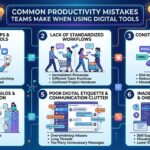
Common Mistakes Teams Make
Even with advanced tools, many teams fail to benefit fully.
Using AI Tools Without Clear Processes
Technology alone does not fix poor workflows.
Overloading Teams with Too Many Tools
Too many platforms create confusion instead of efficiency.
Ignoring Training
Teams need time to understand how to use AI features effectively.
Best Practices for Implementing AI Collaboration Tools
Start With One Core Tool
Avoid switching between multiple systems.
Define Clear Workflows
AI works best when processes are structured.
Monitor Results
Track improvements in time, productivity, and communication.
Encourage Team Adoption
Ensure everyone uses the tool consistently.
Challenges and Limitations
AI tools are powerful, but not perfect.
- Over-reliance on automation
- Data privacy concerns
- Learning curve for new users
- Cost for advanced features
Understanding these limitations helps teams use AI tools responsibly.
The Future of Remote Work With AI
Looking ahead, AI collaboration tools are expected to:
- Predict project outcomes before delays happen
- Automate entire workflows
- Personalize work environments for each employee
- Integrate deeply with all digital tools
This means remote work will become not just easier — but smarter and more adaptive.
AI collaboration tools are transforming remote work from a reactive process into a proactive, intelligent system. By automating routine tasks, improving communication, and providing actionable insights, these tools help teams work more efficiently and with greater clarity.
For remote teams looking to improve productivity and reduce operational friction, adopting AI-powered collaboration tools is no longer optional — it is becoming a practical necessity.
FAQ
Q1: Are AI collaboration tools suitable for small teams?
Yes, even small teams benefit from automation and improved task organization.
Q2: Do AI tools replace human decision-making?
No, they support decisions by providing data and insights.
Q3: Are these tools difficult to use?
Most modern tools are designed with user-friendly interfaces, but some learning is required.
Q4: Can AI tools improve remote team productivity?
Yes, especially by reducing repetitive tasks and improving communication clarity.