Remote work has become a normal part of modern life. Many people now work from home, coffee shops, or different time zones. While this flexibility is valuable, it also introduces a common problem: feeling overwhelmed by tasks, tools, and constant digital communication.
Most remote workers don’t struggle because they lack tools. They struggle because they lack structure.
In this article, we will explore how remote workers stay organized in real-life situations, what systems actually help reduce stress, and why some productivity methods fail even when they look perfect on paper.
Why Remote Work Often Feels Overwhelming
At first, remote work seems simple. No commute, flexible schedule, and more independence. But after a while, many workers experience:
- Too many open tasks at the same time
- Constant notifications from apps
- Unclear priorities from teams
- Difficulty separating work and personal life
The main issue is not workload alone—it is lack of organization systems.
Without structure, even small tasks feel mentally heavy.
How Organized Remote Workers Think Differently
Highly organized remote workers don’t rely on memory. Instead, they rely on systems.
They usually follow three mental principles:
1. Everything has a place
Tasks, notes, and files are stored in specific locations, not scattered across apps.
2. If it’s not written, it doesn’t exist
They don’t trust memory. Everything is documented.
3. Work is processed, not remembered
Instead of thinking constantly about tasks, they process them in scheduled time blocks.
Practical Systems That Actually Work
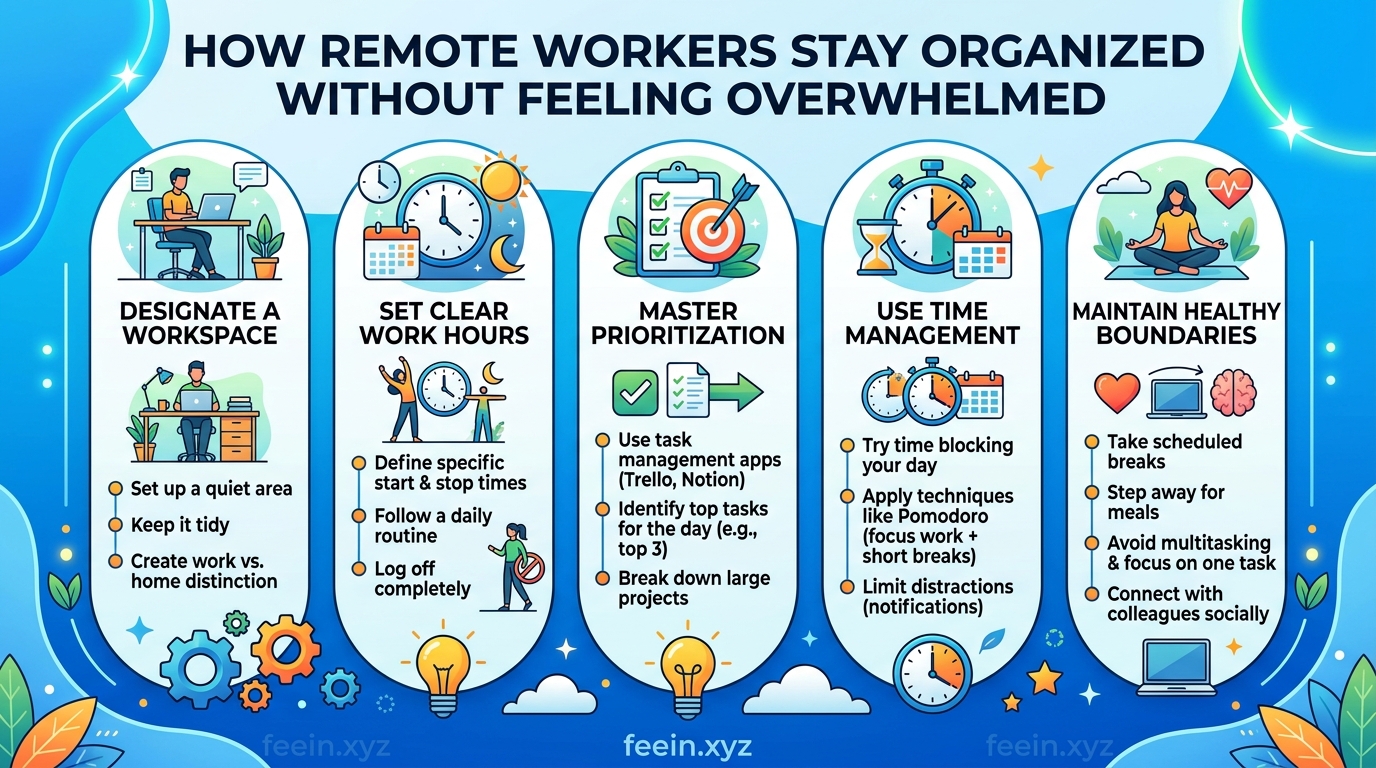
1. The Single Task Hub Method
Instead of using multiple apps, organized workers often use one central system for tasks.
This could be:
- Notion
- Trello
- Asana
The key is not the tool—it is consistency.
All tasks go into one place, preventing mental overload caused by switching apps.
2. Time Blocking Instead of Multitasking
One major cause of overwhelm is multitasking.
Remote workers who stay organized usually:
- Divide their day into time blocks
- Assign specific tasks to each block
- Avoid switching tasks constantly
Example:
- 9:00–11:00 → deep work
- 11:00–12:00 → emails
- 1:00–3:00 → project tasks
This reduces decision fatigue.
3. Daily Reset Routine
At the end of the day, organized workers do a short reset:
- Review completed tasks
- Move unfinished tasks forward
- Plan the next day
This prevents mental clutter from carrying over.
4. Reducing Notification Noise
One of the biggest sources of stress is notifications.
Highly productive remote workers often:
- Turn off non-essential alerts
- Use scheduled check-ins instead of constant messaging
- Separate communication apps from focus tools
This helps the brain stay focused longer.
Real-Life Example
Consider a remote designer working on multiple clients.
Without organization:
- Messages come from email, Slack, WhatsApp
- Tasks are scattered
- Deadlines are confusing
- Stress builds up quickly
With a system:
- All tasks are placed in one board
- Work is divided into time blocks
- Communication is checked at specific times
The difference is not effort—it is structure.
Why Most Productivity Systems Fail
Many people try productivity apps but stop using them after a few days.
Common reasons include:
- Too complex setup
- Too many features
- No daily routine attached
- Lack of habit consistency
The problem is not the tools—it is over-engineering the system.
Simple systems always outperform complex ones.
The Psychology Behind Feeling Overwhelmed
Feeling overwhelmed usually comes from:
- Too many open loops in the brain
- Unclear priorities
- Constant task switching
When tasks are written down and organized, the brain stops “holding” them mentally, which reduces stress significantly.
This is why simple task management systems are so effective.
Simple Rules to Stay Organized
Remote workers who stay in control usually follow these rules:
- Keep one main task system
- Plan the day before it starts
- Limit work tools to essential ones
- Break large tasks into smaller steps
- Avoid multitasking
These are not advanced techniques—they are consistency habits.
Staying organized in remote work is not about using more tools or advanced systems. It is about reducing complexity and building simple, repeatable habits.
Remote workers who avoid overwhelm usually share one common trait: they rely on systems, not memory or motivation.
Once structure is in place, remote work becomes not only manageable—but much more productive and less stressful.
FAQ
Q1: Do I need productivity apps to stay organized?
Not necessarily. A simple system is more important than the tool itself.
Q2: Why do I feel overwhelmed working remotely?
Usually due to lack of structure, not workload alone.
Q3: Is multitasking bad for productivity?
Yes, it often reduces focus and increases stress.
Q4: What is the simplest way to stay organized?
Use one task list, plan your day, and avoid constant switching between apps.