Every day, millions of people use apps and digital services without realizing how much communication happens behind the scenes.
When you:
- log into a website using Google,
- check the weather on your phone,
- book a ride through a transportation app,
- make an online payment,
- or watch live data update instantly,
there is a high chance APIs are working in the background.
APIs are one of the most important technologies powering the modern internet. Yet many people hear the term “API” without fully understanding what it actually means.
In simple terms, APIs allow different software systems to communicate with each other efficiently and securely.
This article explains:
- what APIs are,
- how they work in real-world situations,
- why modern apps depend on them,
- common API types,
- security considerations,
- and how APIs quietly shape everyday digital experiences.
Rather than focusing only on technical definitions, this guide uses practical examples to explain APIs in a more understandable way.
What Is an API?
API stands for Application Programming Interface.
An API acts as a bridge that allows one application to request information or services from another application.
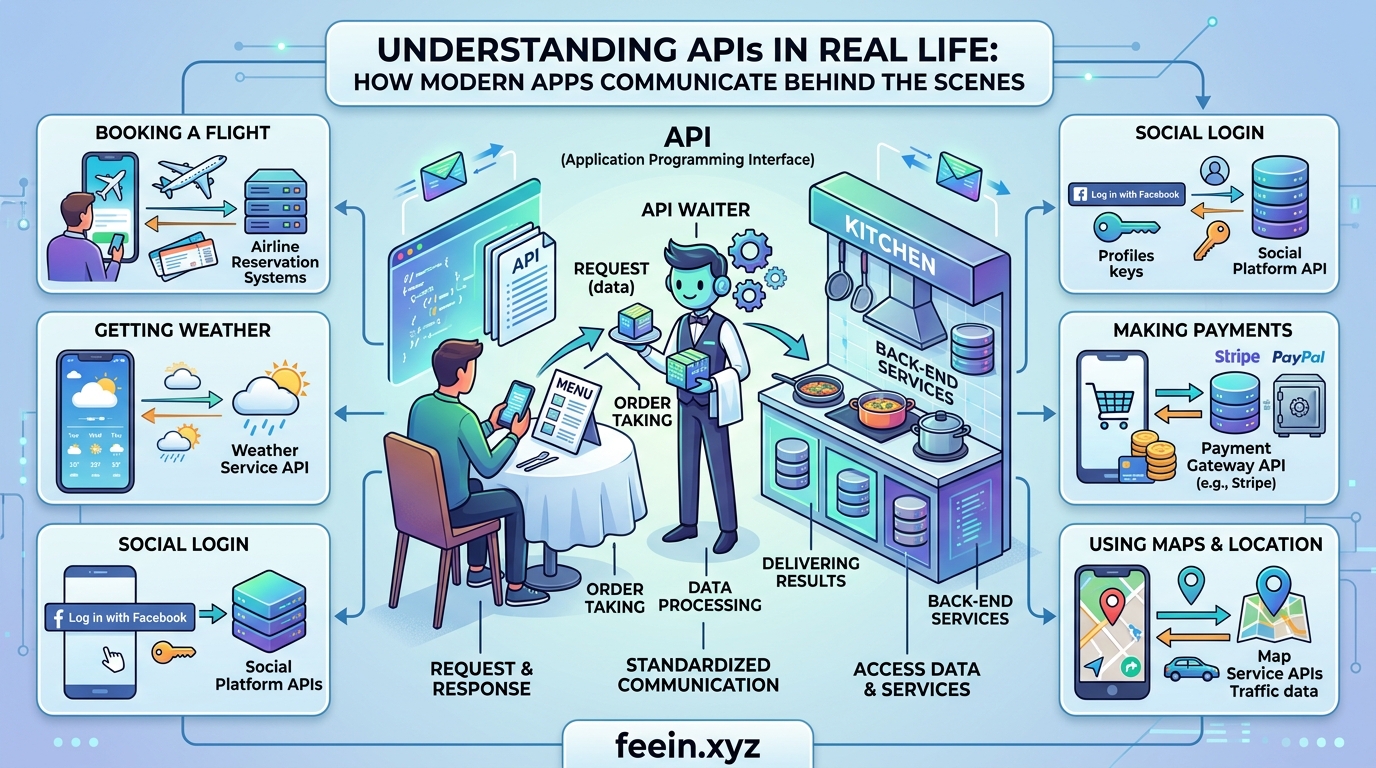
Think of an API like a waiter in a restaurant:
- You (the user) place an order.
- The waiter (API) delivers the request to the kitchen.
- The kitchen prepares the food.
- The waiter brings the response back to you.
You do not need to know how the kitchen works internally. The API handles communication between both sides.
Similarly, apps use APIs to exchange information without exposing their entire internal systems.
Why APIs Became Essential in Modern Technology
Modern applications are extremely complex.
Instead of building every feature from scratch, developers use APIs to connect services together.
This approach:
- saves development time,
- improves scalability,
- increases flexibility,
- allows faster innovation.
For example, a shopping app may use:
- one API for payments,
- another for maps,
- another for shipping calculations,
- another for customer authentication.
Without APIs, many digital services would become far slower and more expensive to develop.
Real World Example: Weather Apps
When you open a weather application, the app usually does not generate weather data itself.
Instead:
- the app sends a request to a weather service API,
- the API provides current forecasts and temperature data,
- the app displays the information in a user-friendly format.
The weather app acts as the interface, while the API delivers the actual data.
This process often happens in seconds.
Real World Example: Login With Google
Many websites allow users to:
- “Sign in with Google”
- “Continue with Apple”
- “Login with Facebook”
This works through APIs.
Instead of creating a completely separate account system, websites communicate with authentication APIs provided by these companies.
The process typically works like this:
- you click the login button,
- the website sends a secure request,
- Google verifies your identity,
- access is approved,
- you return to the app already authenticated.
This simplifies login experiences while reducing password management complexity.
How APIs Work Behind the Scenes
APIs usually operate through requests and responses.
Step 1: The Request
An application asks another system for information or services.
Example:
“Give me today’s weather forecast for Montreal.”
Step 2: The API Processes the Request
The server checks:
- permissions,
- authentication,
- data availability.
Step 3: The Response
The API sends information back in a structured format.
The receiving application then displays the data to the user.
This process often occurs almost instantly.
Common API Types in Everyday Technology
Modern technology relies on many different API categories.
1. Web APIs
Web APIs are the most common type today.
They operate through the internet and connect:
- websites,
- mobile apps,
- cloud platforms,
- online services.
Examples:
- weather data,
- payment processing,
- social media integration.
2. Payment APIs
Online stores frequently use payment APIs.
When a customer submits payment information:
- the website securely communicates with payment systems,
- authorization is verified,
- transaction results are returned instantly.
This allows businesses to process payments without storing sensitive financial data directly.
3. Maps and Location APIs
Many delivery and transportation apps use map APIs.
These APIs provide:
- directions,
- distance calculations,
- live traffic updates,
- estimated arrival times.
Without APIs, building global mapping systems independently would be extremely difficult.
4. Cloud Storage APIs
Cloud platforms use APIs to:
- upload files,
- synchronize devices,
- share documents,
- manage backups.
This enables seamless file access across multiple devices.
Why APIs Improve User Experience
APIs help apps become:
- faster,
- smarter,
- more connected,
- more personalized.
Instead of building isolated systems, APIs allow services to cooperate efficiently.
Users benefit from:
- real-time updates,
- simplified logins,
- integrated services,
- smoother workflows.
Most modern digital convenience depends heavily on APIs.
APIs and Mobile Applications
Smartphones constantly use APIs behind the scenes.
Examples include:
- weather widgets,
- push notifications,
- ride-sharing apps,
- banking apps,
- food delivery services.
Even simple actions like refreshing a social media feed involve multiple API requests.
Modern mobile experiences would be impossible without API communication.
Technical Insight: APIs Reduce System Complexity
One major advantage of APIs is modularity.
Instead of one giant software system handling everything internally:
- services are divided into specialized components,
- APIs allow those components to communicate efficiently.
This improves:
- scalability,
- maintenance,
- reliability,
- development speed.
Large platforms may operate thousands of APIs simultaneously.
API Security and Privacy
Because APIs exchange sensitive information, security is extremely important.
Modern APIs often use:
- encryption,
- authentication tokens,
- rate limiting,
- permission controls.
Without proper protection:
- attackers could access sensitive data,
- systems could become overloaded,
- services could be abused.
API security has become a major focus in modern software development.
Common Misconceptions About APIs
APIs Are Only for Developers
While developers build APIs, everyday users interact with them constantly through apps and websites.
APIs Store All the Data
APIs usually act as messengers between systems rather than permanent storage systems themselves.
APIs Are Only for Large Companies
Even small businesses use APIs today for:
- payments,
- analytics,
- customer support,
- scheduling,
- marketing tools.
How APIs Help Businesses Grow Faster
APIs allow businesses to:
- launch services faster,
- integrate advanced features,
- automate workflows,
- improve customer experiences.
Instead of reinventing existing technology, companies can focus on their core products while connecting external services through APIs.
This is one reason APIs became central to modern digital economies.
The Future of APIs
APIs continue evolving alongside cloud computing and artificial intelligence.
Future trends include:
- AI-powered APIs,
- faster real-time communication,
- improved automation,
- smarter integrations,
- machine-to-machine collaboration.
As digital systems become more interconnected, APIs will become even more essential.
APIs quietly power many of the digital experiences people use every day.
From logging into websites to checking weather forecasts and processing online payments, APIs enable modern applications to communicate securely and efficiently behind the scenes.
Understanding APIs helps explain how today’s connected digital world operates.
Rather than isolated programs, modern apps function as networks of services working together through APIs — making technology faster, smarter, and more convenient for users everywhere.
Frequently Asked Questions
What does API stand for?
API stands for Application Programming Interface.
Do APIs work only online?
Most modern APIs operate through the internet, although some also function locally within software systems.
Are APIs secure?
Well-designed APIs use encryption, authentication, and security controls to protect data and systems.
Why do apps rely so heavily on APIs?
APIs allow apps to connect services efficiently instead of building every feature independently.
Can small businesses use APIs?
Yes. Many small businesses use APIs for payments, scheduling, analytics, communication tools, and cloud services.