
Introduction
In today’s digital world, privacy is more important than ever. Many people use tools like VPNs and proxies to protect their online activities, but these technologies are often misunderstood. Choosing the right option can make a big difference in security, privacy, and internet performance.
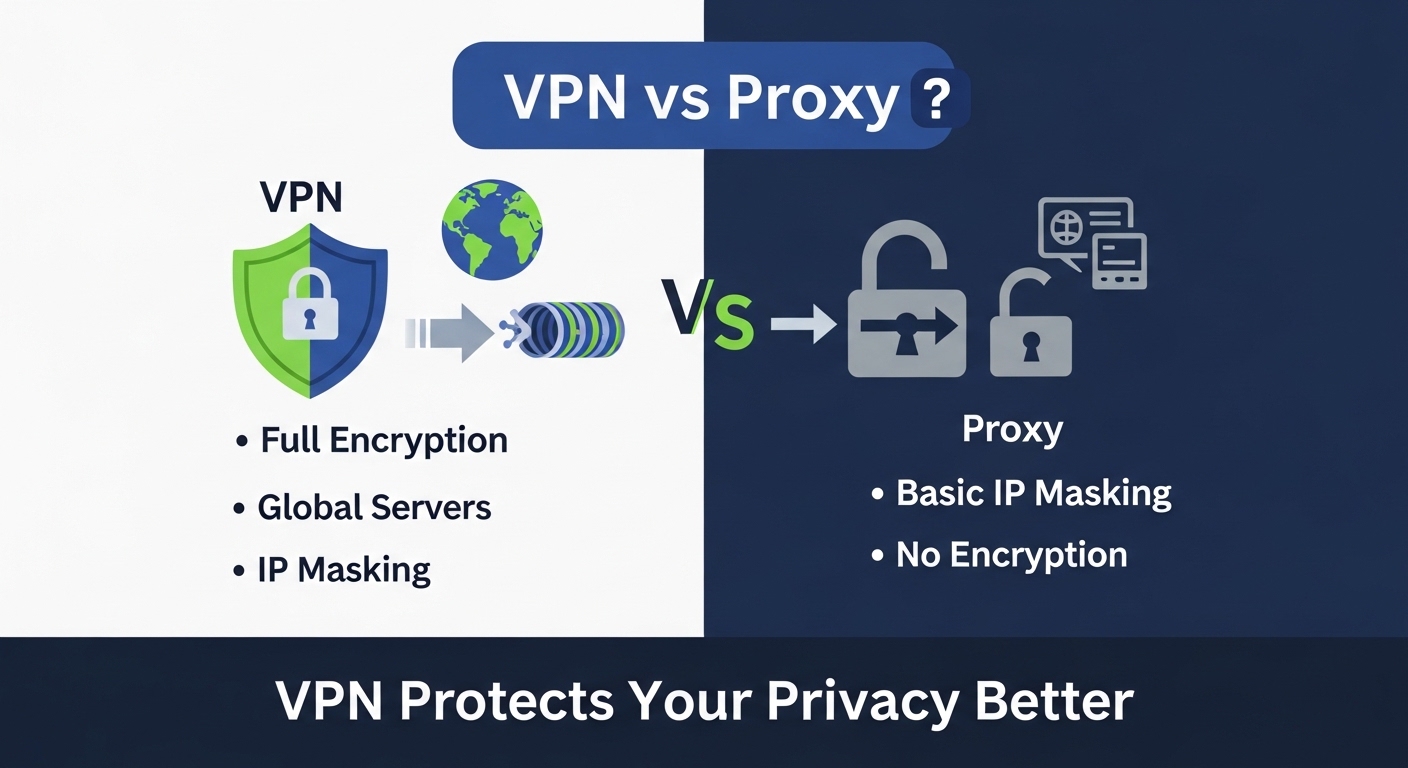
In this guide, we’ll explain how VPNs and proxies work, their differences, and which one is most suitable for your needs.
What Is a VPN?
A Virtual Private Network (VPN) is a service that creates a secure, encrypted connection between your device and the internet. When using a VPN:
-
Your internet traffic is routed through a private server.
-
Your IP address is hidden, making your online activity harder to trace.
-
Data is encrypted, which protects sensitive information from hackers and third parties.
VPNs are commonly used for:
-
Enhancing privacy when using public Wi-Fi
-
Protecting sensitive data
-
Accessing region-restricted content
What Is a Proxy?
A proxy server acts as an intermediary between your device and the internet. When you connect to a website through a proxy:
-
The website sees the proxy’s IP address instead of yours.
-
Some proxies can cache content to improve loading speed.
However, most proxies do not encrypt your traffic, meaning that your data could still be intercepted. Proxies are often used for:
-
Bypassing basic geographic restrictions
-
Hiding IP addresses in less sensitive situations
-
Lightweight internet browsing
Key Differences Between VPNs and Proxies
| Feature | VPN | Proxy |
|---|---|---|
| Data Encryption | Yes | Usually no |
| IP Address Masking | Yes | Yes |
| Security Level | High | Low to medium |
| Speed | Slightly slower due to encryption | Usually faster |
| Use Cases | Secure browsing, privacy, public Wi-Fi | Basic browsing, geo-restriction bypass |
Summary: VPNs provide a higher level of security and privacy because of encryption. Proxies offer basic IP masking without full protection.
Which One Should You Use?
Choosing between a VPN and a proxy depends on your goals:
-
Use a VPN if:
-
You handle sensitive data
-
You frequently use public Wi-Fi
-
Privacy is your top priority
-
-
Use a Proxy if:
-
You only need to access geo-restricted content
-
You are performing casual browsing
-
Security is not a major concern
-
For most users who want online privacy and security, a VPN is the safer and more reliable choice.
Tips for Protecting Your Privacy Online
-
Choose a trusted VPN provider with a clear privacy policy.
-
Update your software regularly to protect against security vulnerabilities.
-
Be cautious with free VPNs or proxies, as some may log your data.
-
Combine privacy tools with strong passwords and two-factor authentication.
Conclusion
Both VPNs and proxies can help protect your identity online, but they serve different purposes. VPNs offer stronger security through encryption, while proxies mainly hide your IP address. Understanding these differences helps you make informed decisions about online privacy.
By using these tools correctly and following basic privacy practices, you can significantly reduce the risk of data exposure and browse the internet with more confidence.
FAQ
Q1: Can a proxy provide the same security as a VPN?
A1: No. Proxies usually do not encrypt data, so a VPN offers much stronger privacy protection.
Q2: Will a VPN slow down my internet?
A2: Some VPNs may slightly reduce speed due to encryption, but the difference is often minimal with quality providers.
Q3: Are free VPNs safe?
A3: Free VPNs may log data or have limited security. Paid, reputable VPNs are generally safer.
Q4: Can I use both a VPN and a proxy together?
A4: Yes, but for most users, a VPN alone provides sufficient privacy and security.