
Introduction
In today’s digital world, almost every app, website, or software you use relies on APIs. But what exactly is an API, and why is it so important?
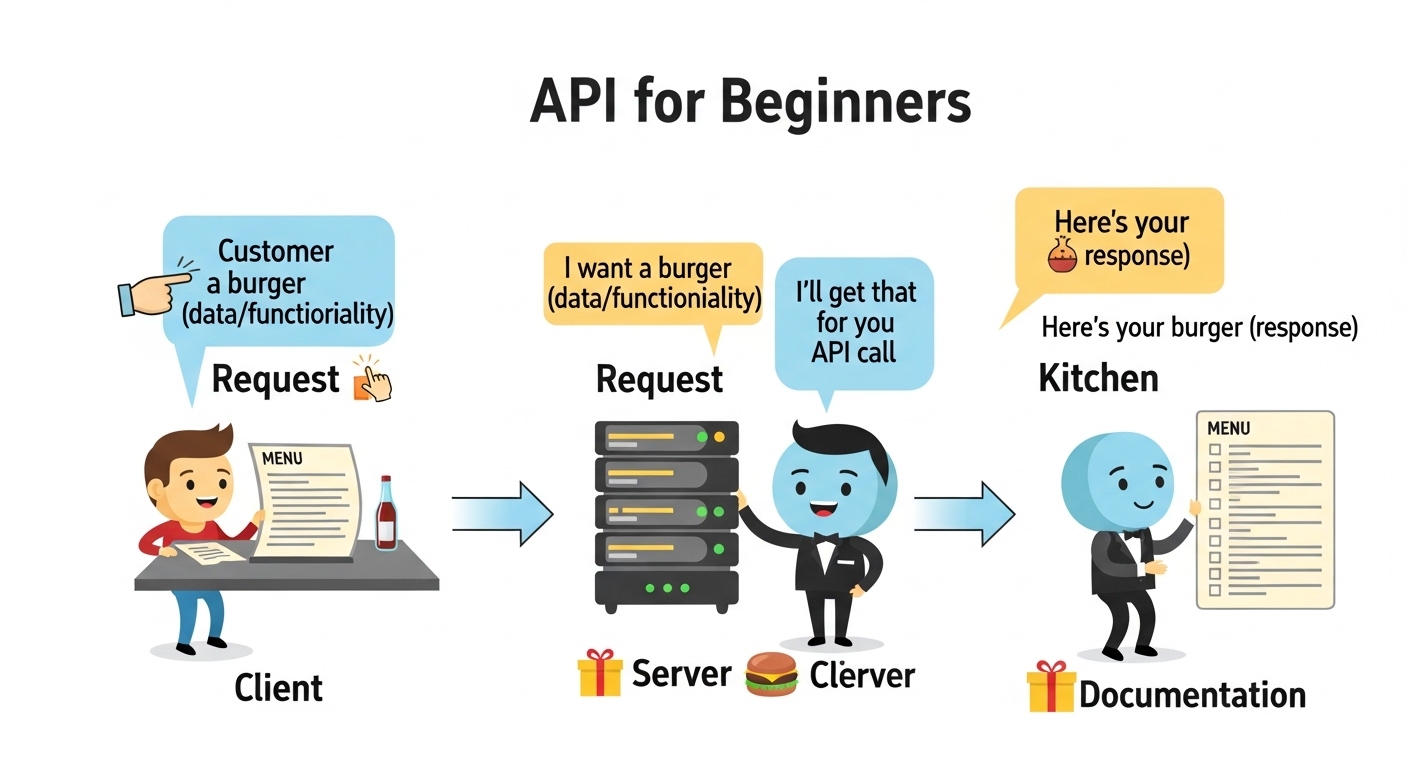
An API, or Application Programming Interface, is like a bridge that allows different software applications to communicate with each other. Understanding APIs can help beginners grasp how modern technology works behind the scenes.
In this guide, we’ll explain what APIs are, how they function, their types, and practical examples for beginners.
What Is an API?
An API (Application Programming Interface) is a set of rules that allows one software program to interact with another.
Think of it like a restaurant menu:
-
The menu lists what you can order (what the software can request).
-
The kitchen prepares your order (the software processes the request).
-
The waiter delivers your food (the API sends the data back).
In simple terms, an API defines how software should request and exchange information.
How Do APIs Work?
APIs work through a series of steps:
-
Request: One application sends a request to another application through the API.
-
Processing: The receiving application processes the request according to its rules.
-
Response: The API sends the results back to the requesting application.
For example:
-
A weather app requests the current temperature from a weather API.
-
The API fetches the data from the server.
-
The app displays the temperature on your screen.
Types of APIs
APIs come in different forms depending on their purpose:
-
Open/Public APIs – Available to anyone, like Google Maps API.
-
Partner APIs – Shared with specific business partners.
-
Internal/Private APIs – Used internally within a company.
-
Composite APIs – Combine multiple API calls into one request for efficiency.
Why Are APIs Important?
APIs are essential because they:
-
Enable Integration: Connect apps and services seamlessly.
-
Save Time: Developers don’t have to build everything from scratch.
-
Allow Automation: Tasks can run automatically between software systems.
-
Enhance User Experience: Apps can offer richer features using external services.
Practical Examples of APIs
-
Social Media Integration: Logging into a website using Facebook or Google.
-
Payment Systems: Using PayPal or Stripe APIs to process payments.
-
Maps & Navigation: Google Maps API for location services in apps.
-
Data Access: Accessing stock prices, weather updates, or sports scores.
Best Practices for Beginners
-
Always read the API documentation before use.
-
Test API calls with tools like Postman.
-
Handle errors gracefully to avoid app crashes.
-
Respect rate limits to prevent being blocked.
Conclusion
APIs are the backbone of modern software, connecting apps, websites, and services efficiently. By understanding what APIs are and how they work, beginners can appreciate the technology behind everyday digital tools and start exploring software development confidently.
FAQ
Q1: Can I use APIs without programming knowledge?
A1: Yes, some APIs have no-code platforms that allow integration without coding, though learning basic programming helps.
Q2: Are APIs free to use?
A2: Some APIs are free, especially public APIs, while others require subscriptions or payment.
Q3: How do I start learning APIs?
A3: Begin by exploring public APIs, reading their documentation, and experimenting with simple requests using tools like Postman.
Q4: Do all apps use APIs?
A4: Most modern apps rely on APIs to connect services, fetch data, and provide features efficiently.