Autonomous vehicles (AVs), commonly known as self‑driving cars, represent one of the most advanced technological developments in transportation today. These vehicles can perceive their surroundings, interpret data, and make driving decisions with minimal or no human intervention.
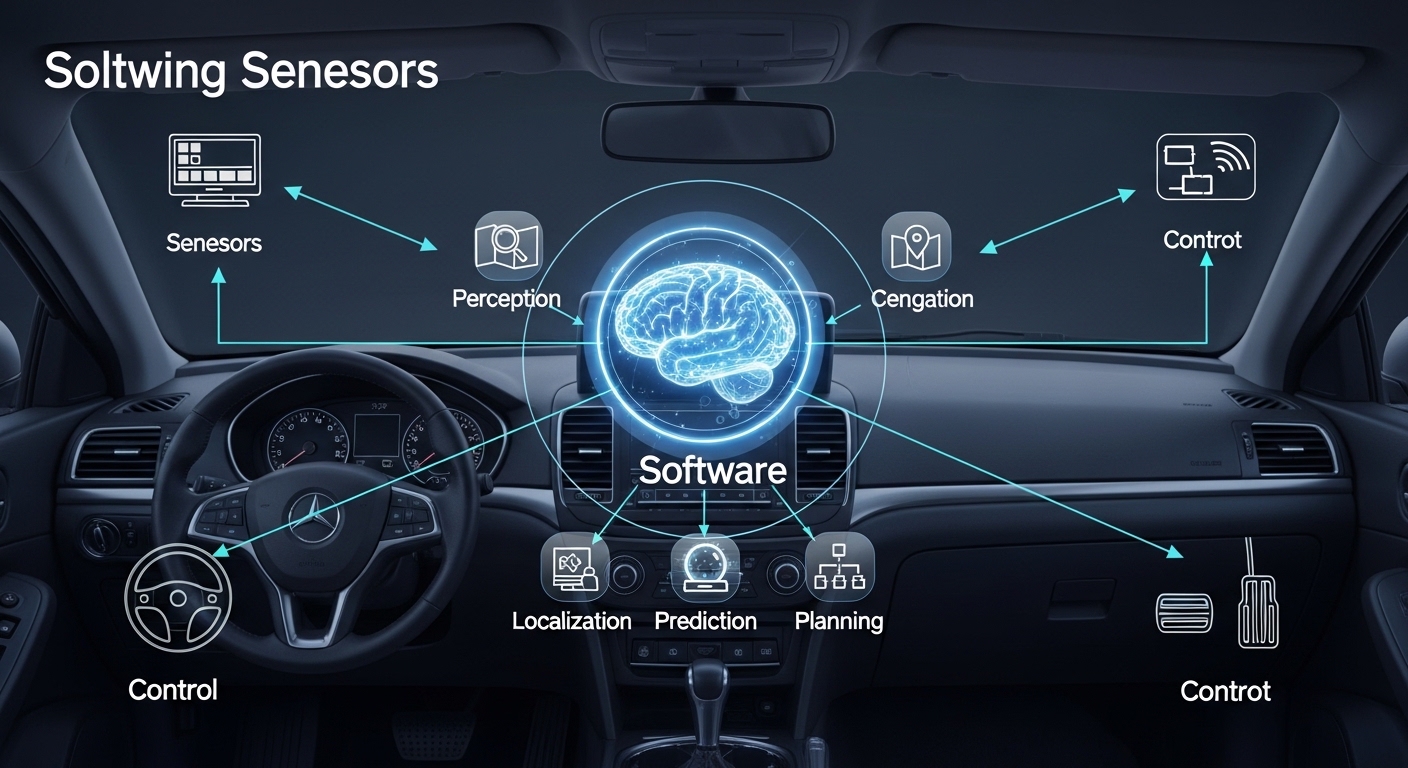
This capability relies on a sophisticated combination of sensors, mapping systems, software algorithms, and artificial intelligence (AI) that work together to create a reliable picture of the vehicle’s environment and determine safe actions to take. In this article, we explain how these technologies operate, how they interact, and why this system is essential for reliable autonomous driving.
What Are Autonomous Vehicles?
Autonomous vehicles are cars designed to drive themselves by combining hardware and software systems that replicate human perception and decision‑making.
These vehicles are often described in terms of levels, from Level 0 (no automation) to Level 5 (full autonomy), indicating how much control is required from the human driver. Most vehicles on the road today with advanced driver assistance systems (ADAS) still require human supervision, while fully autonomous systems remain in development and testing phases.
The Sensor Suite — Eyes and Ears of Autonomous Cars
AVs use a wide range of sensors to “sense” their surroundings. No single sensor can provide complete awareness, so multiple types are used in combination — a concept known as sensor fusion.
LiDAR
LiDAR sensors emit laser pulses and measure the time it takes for the reflections to return. These measurements create a detailed 3D map of the environment around the vehicle with centimeter‑level accuracy, which helps in object detection and distance measurement.
Radar
Radar systems use radio waves to determine the range, velocity, and angle of objects around the car. works well in poor weather conditions (rain, fog, dust) where visual systems may struggle.
Cameras
Cameras capture high‑resolution visual data that help identify road signs, lane markings, pedestrians, and other visual details essential for scene understanding. These visual inputs are processed by computer vision algorithms.
Ultrasonic Sensors
Typically located around the vehicle’s perimeter, these sensors detect nearby obstacles at short distances — especially useful in low‑speed maneuvers like parking.
GPS, IMU, and Mapping Systems
GPS provides location positioning, while inertial measurement units (IMUs) track motion dynamics. High‑definition maps (HD maps) supplement sensor data by giving detailed road and environment models that help with precise localization.
Sensor Fusion — Combining All Inputs
Individually, each sensor has strengths and weaknesses. For example, LiDAR generates accurate spatial data but is costly and can be limited in bad weather, whereas radar is robust but has lower resolution.
Sensor fusion combines data from all sensors to create a unified understanding of the environment, minimizing weaknesses and increasing accuracy. This process is powered by advanced algorithms — often involving AI and deep learning — that filter, align, and interpret data from different sources.
Software Architecture in Autonomous Vehicles
Once the vehicle gathers raw data from sensors, it must process and interpret that information. This is where software plays a critical role. Transportation software generally consists of several key modules:
Perception Module
This system interprets sensor data and identifies objects like vehicles, pedestrians, traffic signs, and obstacles. Computer vision and deep learning models are essential here.
Localization and Mapping
Combines GPS, HD maps, and sensor data to determine the exact position of the vehicle with high precision.
Planning Module
Using data from perception and localization modules, planning determines the best possible path for the vehicle while considering traffic rules, obstacles, and goals.
Control Module
Translates decisions into actions — controlling steering, brakes, acceleration, and other vehicle functions in real time.
Artificial Intelligence and Machine Learning
AI is critical in autonomous driving. Machine learning models are trained on millions of miles of driving data to recognize patterns, predict potential hazards, and make split‑second decisions based on environmental input. This includes predicting pedestrian movement, anticipating vehicle behavior, or reacting to unexpected obstacles.
High‑Definition Maps and Real‑Time Navigation
Autonomous vehicles often use HD maps — far more detailed than typical GPS maps — that include lane markings, traffic signs, and accurate roadway geometry.
These maps help the vehicle anticipate routes and support the localization system to improve decision accuracy.
Real‑World Applications and Companies
Several companies are advancing self‑driving technology in real environments:
-
Waymo: Uses full sensor fusion with LiDAR, radar, and cameras for its autonomous fleet.
-
Tesla: Focuses on camera‑driven systems with neural networks interpreting visual data.
These trials offer real insight into how autonomous software and sensors adapt to complex urban conditions.
Benefits and Challenges
Benefits
-
Reduced driver fatigue and human error
-
Potential increase in road safety
-
Enhanced mobility for people with limited driving ability
Challenges
-
High computational cost
-
Weather conditions affecting sensors
-
Legal and ethical concerns
-
Cybersecurity risks
Ongoing research continues to address these limitations.
Future of Autonomous Driving
The future field of autonomous driving is expected to integrate even more advanced AI, improved sensor technologies, and enhanced communication systems such as vehicle‑to‑everything (V2X) networks, which can allow vehicles to communicate with infrastructure and other cars.
Autonomous vehicles are powered by a sophisticated integration of sensors, advanced software, and AI. By combining multiple sensor inputs through sensor fusion, constantly updating high‑definition maps, and using machine learning for decision‑making, these vehicles are increasingly capable of navigating complex environments with minimal human intervention.
This synergy between hardware and software provides a promising foundation for a safer and more efficient future on the roads.
FAQ
Q1: What is sensor fusion in autonomous vehicles?
Sensor fusion combines data from cameras, LiDAR, radar, and other sensors to create a reliable environmental model.
Q2: Do autonomous vehicles need AI?
Yes, AI and machine learning are needed to interpret sensor data and make real‑time decisions.
Q3: Can current autonomous vehicles drive in all weather conditions?
Not yet — extreme weather can affect sensor performance and remains a key challenge.