Introduction
Drones, also known as unmanned aerial vehicles (UAVs), have become increasingly common in recent years. What once seemed like advanced military technology is now used in photography, agriculture, construction, research, and even emergency response.
But how do drones actually work? What allows them to stay stable in the air, respond to remote controls, and capture high-quality data?
In this guide, we’ll explore the basic technology behind drones, the main components that make them fly, and the practical applications that make them valuable across multiple industries.
What Is a Drone?
A drone is a flying device that operates without a pilot onboard. It is controlled either remotely by a person or autonomously using pre-programmed flight software.
Most consumer and commercial drones use multiple rotors (usually four), which is why they are often called quadcopters. However, there are also fixed-wing drones and hybrid models designed for specialized uses.
Main Components of a Drone
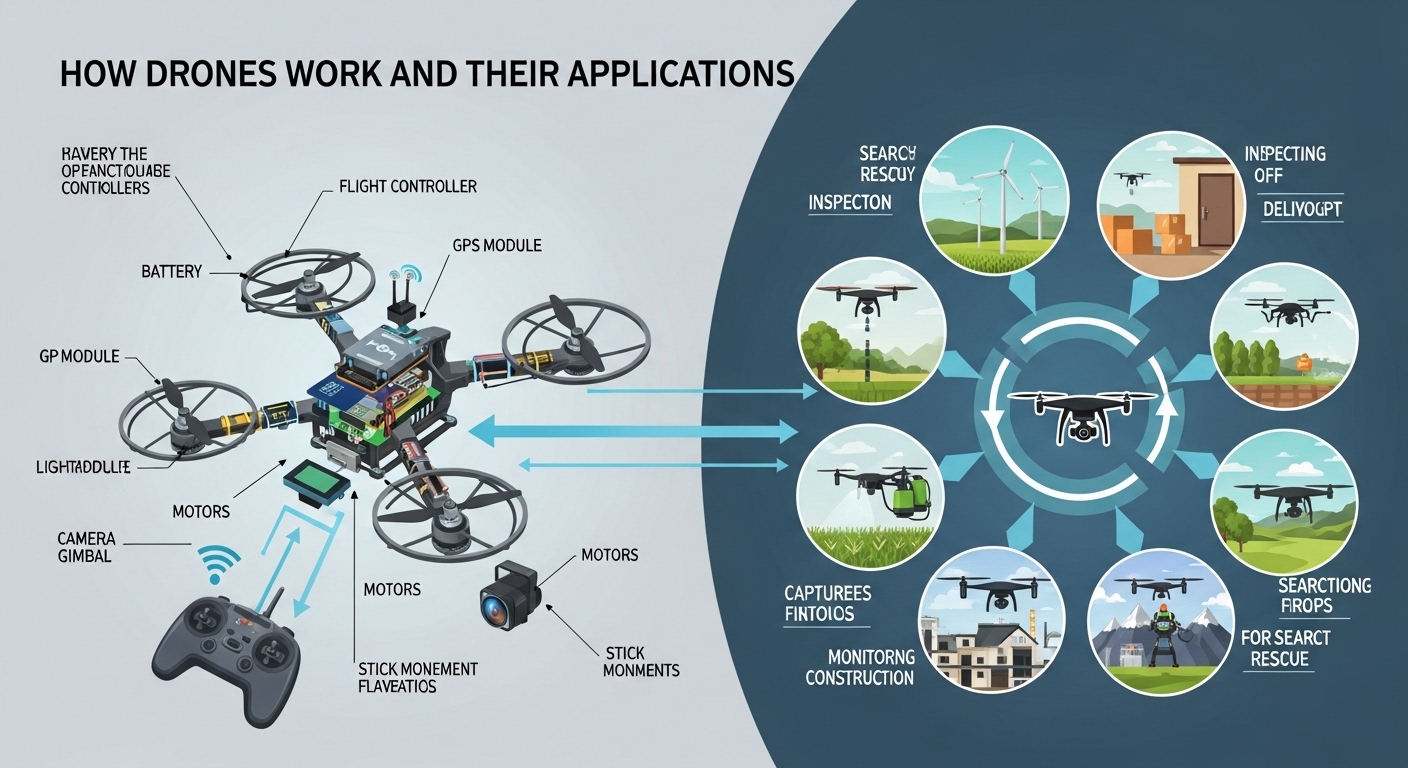
Although drones vary in size and purpose, most share the same essential components:
1. Frame
The frame is the physical structure that holds all parts together. It must be lightweight yet strong enough to handle wind and impact.
2. Motors and Propellers
Electric motors spin the propellers at high speeds. The difference in speed between the propellers allows the drone to move in different directions.
For example:
-
Increasing speed on all propellers makes the drone rise.
-
Slowing them down gradually brings it back down.
-
Adjusting speed on one side allows turning or tilting.
3. Flight Controller
The flight controller acts as the drone’s “brain.” It processes input from the remote control and onboard sensors, then adjusts motor speeds to maintain balance and direction.
Without a flight controller, stable flight would not be possible.
4. Sensors and GPS
Modern drones use several sensors, including:
-
Gyroscopes (to detect rotation)
-
Accelerometers (to measure movement)
-
GPS modules (for positioning)
These sensors help the drone maintain stability, hover in place, and return automatically to its starting point if needed.
5. Battery
Most drones use rechargeable lithium-based batteries. Battery capacity directly affects flight time, which typically ranges from 15 to 40 minutes depending on the model.
How Drones Stay Stable in the Air
One of the most impressive features of modern drones is their ability to hover steadily. This stability comes from constant adjustments made by the flight controller.
The controller continuously receives data from sensors. If wind pushes the drone slightly to one side, the system automatically increases power to certain motors to compensate.
These adjustments happen many times per second, which makes the movement appear smooth and controlled.
Types of Drones
Different drone designs serve different purposes:
Multi-Rotor Drones
-
Most common type
-
Used for photography, inspections, and hobby flying
-
Easy to control and stable
Fixed-Wing Drones
-
Similar to airplanes
-
Longer flight times
-
Often used for mapping large areas
Hybrid Drones
-
Combine vertical takeoff with airplane-style flight
-
Used in advanced commercial operations
Real-World Applications of Drones
Drones are used in a wide range of industries. Below are some of the most common applications:
1. Aerial Photography and Videography
One of the most popular uses of drones is capturing aerial images and videos. They allow photographers to take shots that previously required helicopters or cranes.
2. Agriculture
Farmers use drones to monitor crop health, check irrigation systems, and analyze field conditions. Aerial data can help identify areas that need attention.
3. Construction and Infrastructure
Construction teams use drones to:
-
Survey land
-
Monitor project progress
-
Inspect buildings safely from above
This reduces the need for scaffolding and manual inspections in certain situations.
4. Emergency Response
In search and rescue missions, drones can cover large areas quickly. They provide real-time visuals that help responders assess situations more efficiently.
5. Environmental Research
Researchers use drones to study wildlife, forests, and coastlines. Because drones are less invasive than helicopters, they can reduce disturbance to natural habitats.
Safety and Regulations
Drone use is subject to regulations in many countries. Rules often include:
-
Registering certain drone models
-
Avoiding restricted airspace
-
Maintaining visual line of sight
-
Respecting privacy laws
Before operating a drone, it is important to understand local guidelines to ensure safe and responsible use.
Advantages and Limitations
Advantages
-
Access to hard-to-reach locations
-
Lower cost compared to manned aircraft
-
Quick deployment
-
High-quality data collection
Limitations
-
Limited battery life
-
Weather sensitivity (wind and rain)
-
Regulatory restrictions
Understanding both benefits and limitations helps users choose the right drone for their needs.
Conclusion
Drones combine lightweight engineering, advanced sensors, and intelligent flight control systems to achieve stable and efficient flight. Their ability to capture aerial data safely and affordably has made them valuable tools across many industries.
From photography and agriculture to construction and research, drones continue to expand their role in modern technology. As battery systems and automation improve, their applications are likely to grow even further.
Frequently Asked Questions (FAQ)
Are drones difficult to operate?
Modern consumer drones are designed to be user-friendly, but beginners should still practice in safe, open areas before flying in complex environments.
How long can a drone stay in the air?
Most consumer drones fly between 15 and 40 minutes per charge, depending on battery size and weather conditions.
Do drones require internet to operate?
No, drones use radio signals between the remote controller and the aircraft. However, GPS signals are commonly used for positioning.
Are drones safe to use?
When operated responsibly and according to local regulations, drones are generally safe. Proper maintenance and awareness of surroundings are important.